When organizations hire a speaker, they’re not paying for an hour on a stage.
They’re paying for clarity. For a shift in perspective that helps people think differently, work differently, and lead differently long after the applause fades.
That’s why I don’t think of my work as “giving talks.” I think of it as sharing intellectual property—frameworks and ideas that create lasting change.
I learned this lesson recently while listening to Lois Creamer speak at NSA Ohio. Lois is a master at booking speaking business, and she said something that completely reframed how I think about what I do: “We’re not in the speaking business. We’re in the intellectual property business.”
That single statement changed everything.
Ideas Create Impact, Not Just Inspiration
A good talk can motivate people in the moment. A strong idea changes how people operate when they go back to work.
Here’s what I mean: A few years ago, I was drowning in my own meeting overload. Between coaching clients, speaking engagements, volunteer leadership roles, and strategic planning sessions, I had no time to actually do the work. I was exhausted, behind on everything, and running on fumes.
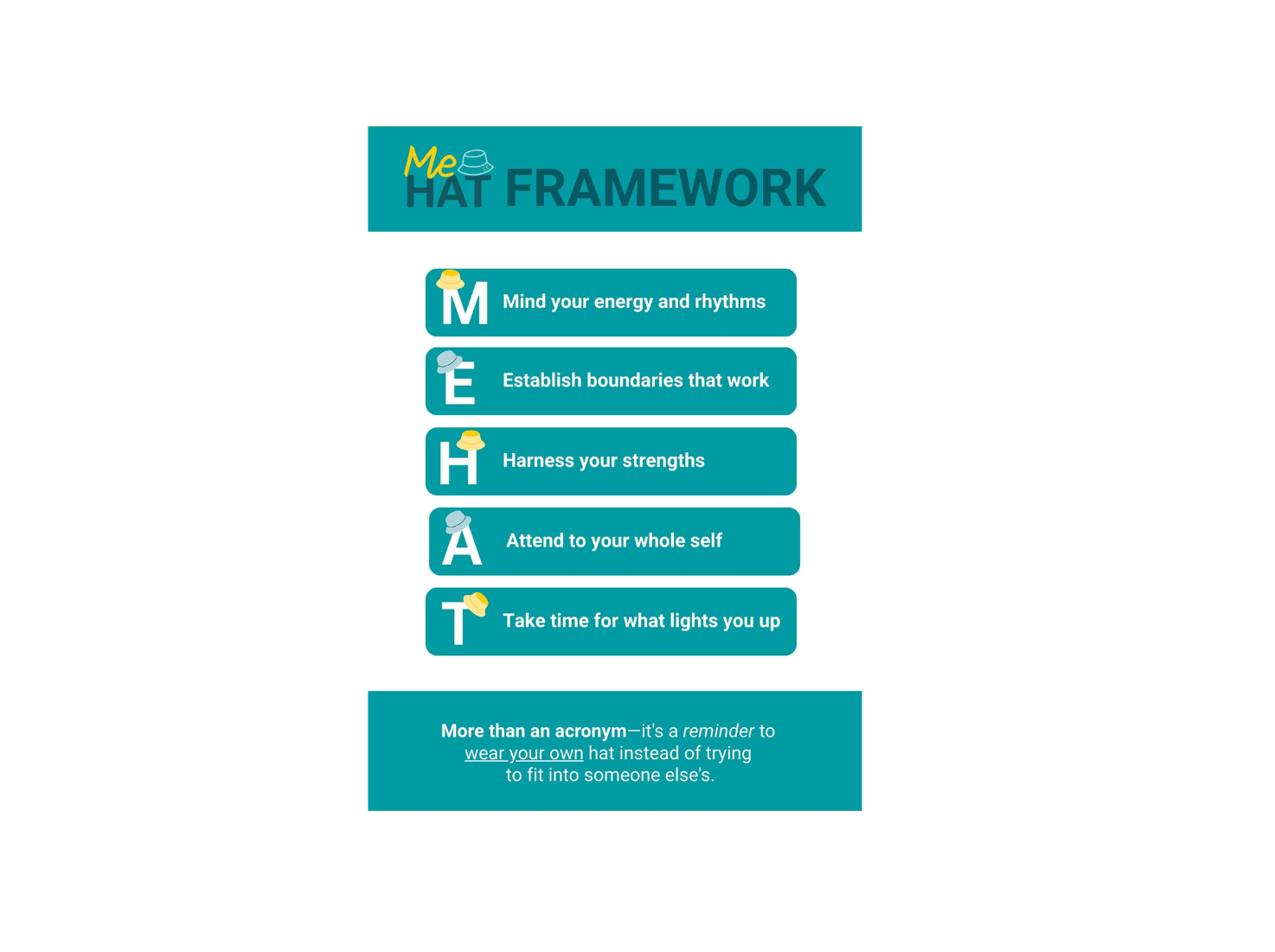
I couldn’t pep-talk my way out of it. I needed a framework—which became the ME HAT framework. A tool for understanding how my brain’s energy actually works and how to structure time accordingly. I learned to protect Mind Energy, establish real boundaries around focus time, and attend to my whole self instead of powering through on willpower alone.
The result? I redesigned my entire schedule. I blocked collaborative work into specific days and protected quiet work time on others. I started sleeping better, feeling less anxious, and—here’s the kicker—actually getting more done.
That framework I created for myself? That’s what I now share with organizations. Because that’s not inspiration—that’s intellectual property at work.
Why Positioning Matters More Than You Think
If you’ve ever landed on a speaker’s website and felt unsure what they actually do, you’ve experienced the cost of unclear positioning.
Lois talked about this too. She said most speakers try to be everything to everyone—and end up being nothing to anyone. They list every possible topic they could speak on, every audience they’ve worked with, every format they offer.
The result? Decision-makers can’t figure out if this speaker is right for their specific need.
Strong positioning isn’t about listing everything a speaker is capable of. It’s about clearly answering one question for the buyer: “Is this person meant for us?”
That clarity builds confidence. And confidence drives decisions.
And here’s my confession: this is a work in progress for me. I struggle with this. So have patience as I continue refining how I talk about my work!
Like many speakers—especially those of us with ADHD—I see connections everywhere. I can talk about executive function and workplace neurodiversity and communication strategies and leadership development, because they’re all interconnected in how I think and work.
But that’s not always helpful for someone trying to figure out if I’m the right fit for their event.
So I’m learning to get clearer. To focus. To make it easier for you to see if what I offer matches what you need.
Think about it from the buyer’s perspective. You’re planning a conference, a training day, or a leadership retreat. You’re scrolling through speaker websites at 10 PM after a long day. You need someone who can address a specific challenge your team is facing—maybe it’s communication breakdowns, maybe it’s burnout, maybe it’s helping neurodivergent employees thrive.
You don’t want to read through fifteen different topics and try to guess which one might fit. You want to land on a site and immediately think, “Yes. This person gets exactly what we’re dealing with.”

Programs, Not “Talks”
I don’t offer a long menu of unrelated keynotes.
I offer a focused set of core programs that can be delivered in different formats—whether that’s a keynote, a workshop, or a full-day experience.
Why? Because fewer, clearer options make it easier for organizations to choose the right fit.
Each program is designed to address a specific challenge, deliver a clear outcome, and provide tools and language teams can continue to use.
Take my “In Their Shoes” ADHD simulation experience. It’s not a lecture about what ADHD is. It’s an experiential program where participants actually feel what it’s like to navigate tasks with executive function challenges. They try to follow multi-step instructions while being interrupted. They attempt to organize information while dealing with working memory limitations. They experience the frustration of knowing what to do but struggling to execute.
And then we debrief. We connect the experience to real workplace scenarios. We talk about accommodations that actually work. We build empathy and understanding that changes how managers lead and how teams collaborate, and teachers teach..
That’s a program. It has a clear structure, specific learning outcomes, and tools participants can use immediately. I can deliver it as a 60-minute keynote experience or expand it into a half-day workshop with deeper skill-building. But the intellectual property—the framework, the insights, the tools—remains consistent.
That’s the difference between a presentation and a program.
The Real Question Organizations Should Ask
When you’re considering a speaker, the most important question isn’t “How entertaining will this be?”
It’s “What will our people be able to do differently afterward?”
Will they have a framework they can apply to their work? Will they have language to describe challenges they’ve been struggling with? Will they have practical tools they can implement immediately?
That’s the work I care about—helping individuals and organizations think differently so they can lead, communicate, and perform in ways that actually last.
Because here’s the truth: your team doesn’t need another motivational talk that makes them feel good for an afternoon and then fades by Tuesday morning. They need intellectual property they can put to work. They need ideas that create systems. They need frameworks that become part of how they operate.
Wear Your Own Hat
Every organization has its own culture, challenges, and strengths.
My role isn’t to give you someone else’s answers. It’s to help you wear your own hat—with clarity, confidence, and intention.
That means I’m not coming in with a one-size-fits-all solution. I’m bringing frameworks and tools that your team can adapt to your specific context. I’m creating space for your people to figure out what works for their brains, their workload, their challenges.
Because the goal isn’t to make everyone operate the same way. It’s to give everyone the understanding and tools they need to operate in the way that works best for them—and to create a culture where that’s not just accepted, but celebrated.
If that sounds like the kind of impact you’re looking for, I’d love to start a conversation.
Ready to explore what’s possible? View my speaking programs or reach out to discuss what you want to accomplish for your team.